TEETH - STRAIGHTENING TREATMENT
SERVICES
RESOURCES
SHOP
MEDICAL CERTIFICATIONS
Certifications ensuring safety, quality, and compliance with global standards.
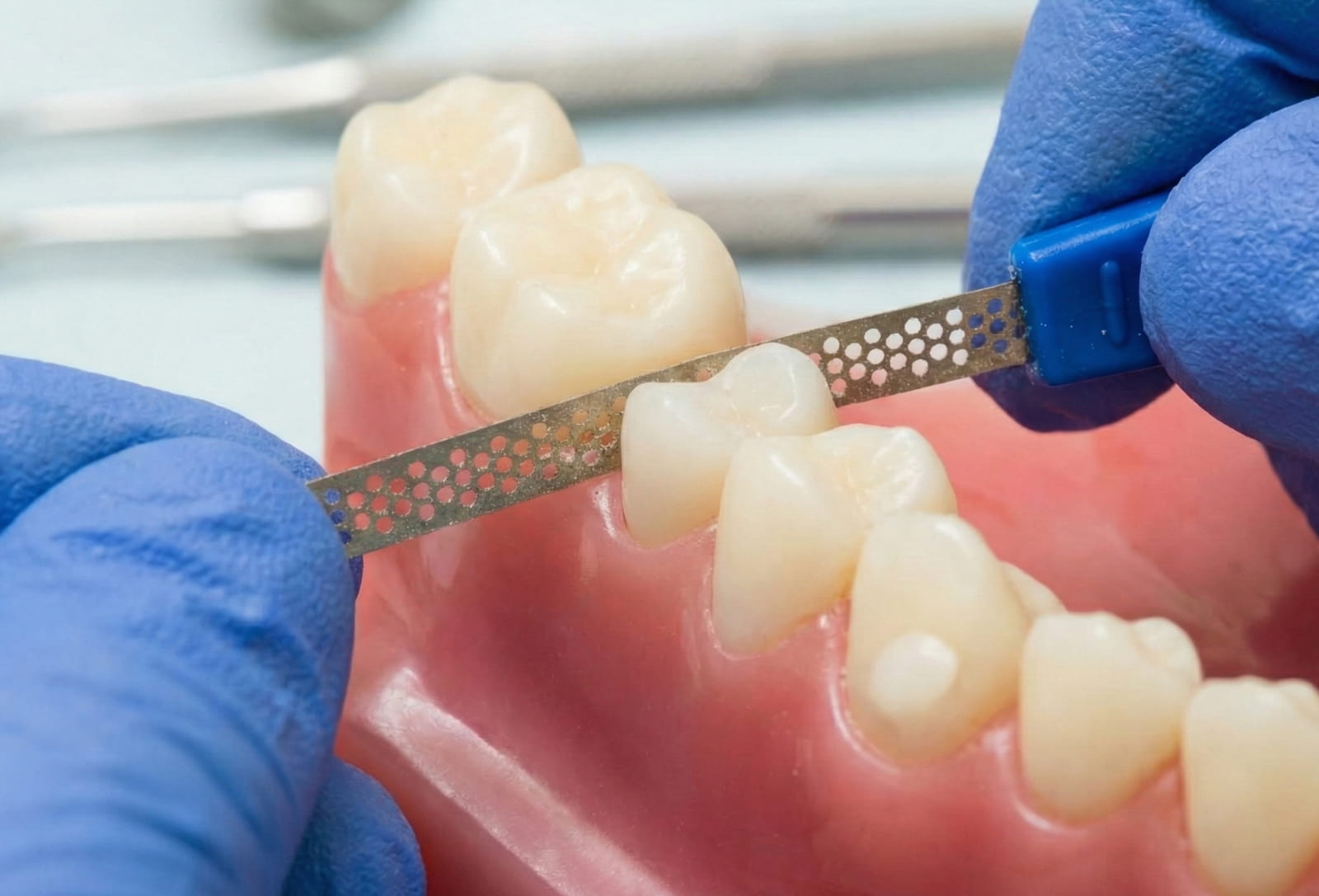

Interproximal reduction, often referred to as IPR, is a common technique employed in modern orthodontics to create small spaces between teeth. It may sound intimidating, but the procedure is quick, painless, and plays an essential role in helping your teeth align properly, especially during clear aligner treatment.
It is a controlled process in which your dentist or orthodontist gently removes a thin layer of enamel between the teeth. The amount removed is usually 0.1–0.5 mm, which is extremely minimal and safe when performed correctly.
IPR helps:
This technique is routinely used in both braces and clear aligner treatments to improve movement and final results.
When teeth overlap, there’s not enough room for them to straighten naturally. IPR teeth techniques create micro-spaces that allow smoother movement during treatment.
Sometimes teeth are slightly disproportionate, too wide or uneven. A small adjustment through IPR can create a more symmetrical smile.
With moderate crowding or a narrow arch, IPR orthodontics helps fine-tune the bite so that upper and lower teeth fit together comfortably.
Without adequate space, teeth may shift back after treatment. IPR ensures long-term stability.
For braces, IPR helps relieve crowding and allows brackets and wires to move teeth more efficiently. Your orthodontist may perform IPR at various stages of treatment to refine alignment.
IPR is widely used because aligners require precise spacing to predictably move teeth. Without IPR, some teeth may not track correctly, or treatment may take longer. Clear aligner planning software typically identifies exactly where and when IPR is needed.
Yes. When done by a trained professional, IPR is considered extremely safe. Only the outer enamel layer is smoothed, which does not cause tooth sensitivity or structural damage. Modern orthodontic systems precisely calculate how much enamel can be removed without compromising tooth health.
Most patients describe IPR as feeling like light sanding or polishing. It should not cause pain. You may feel slight pressure or vibration, but nothing sharp or uncomfortable.
Your dentist may recommend IPR if you have:
IPR is a conservative alternative to extraction. Instead of removing entire teeth to make space, only a tiny bit of enamel is reshaped. This helps maintain your natural smile while still achieving proper alignment.
Interproximal reduction is a simple, effective, and safe technique used to improve orthodontic results. Whether you’re undergoing interproximal reduction with braces or invisible aligners, the goal is the same: to create space so your teeth move predictably and settle into a well-aligned, stable smile.
If you’re considering clear aligners or braces, a professional assessment will help clarify what your teeth need for the best outcome. Contact us today.
Get a free consultation with your orthodontist today to explore your options and take the first step towards achieving the smile of your dreams. Your journey to a confident smile starts now!
What Is IPR? Interproximal reduction, often referred to as IPR, is a common technique employed in modern orthodontics to create ...
1 December 2025
Mouth breathing is more common than people think, and many don’t realise they’re doing it, especially while sleeping. Whether you’ve ...
24 November 2025
Have you noticed your smile looking a little dull lately? It’s very common for teeth to change colour over time, ...
17 November 2025
Have you ever woken up with a dry mouth or a scratchy throat? It’s uncomfortable, and sometimes even sipping water ...
13 November 2025
Flossing is a vital part of maintaining good oral hygiene, especially when you have braces or aligners. While your dentist ...
10 November 2025